If you’ve ever picked up a box of cereal, a lipstick, or a phone accessory, you’ve held a tuck end box without necessarily knowing its name. Tuck end boxes guide are folding cartons with flaps that tuck into the box itself to stay shut, no tape, no glue gun, no fuss. They’re the quiet workhorse of retail packaging, and understanding how they’re built helps you pick the right style, material, and finish before you ever request a quote.
This guide breaks down the anatomy of a tuck end box, compares every major style, from the straight tuck end box to roll end tuck top boxes, and shows you exactly how to specify custom boxes that protect your product and sell it at the same time.
What Are Tuck End Boxes?
A tuck end box is a folding carton where flaps at the top, bottom, or both ends fold inward and tuck into slots or against the box body to hold it closed. The mechanism relies on friction and fold memory in the paperboard rather than adhesive, which is why these boxes ship flat, assemble in seconds, and can be opened and reclosed by hand.
Because the closure lives in the fold rather than in a glue line, a tuck flap box can be redesigned quickly for new sizes or SKUs, one reason contract packagers lean on this style across cosmetics, food, electronics, pharma, and subscription boxes.
Anatomy of a Tuck End Boxes Guide
Every tuck end box, regardless of style, breaks down into four structural elements:
- Main body — the four panels that wrap around the product, sized to its length, width, and depth.
- Tuck flaps — extensions at the open end(s) that fold in and lock against the inside panel.
- Dust flaps — shorter side flaps that close first, sealing the corners against dust and moisture before the tuck flap goes down.
- Glue flap — a narrow panel on one side of the main body, adhered during manufacturing to form the box into a tube before it’s shipped flat to you.
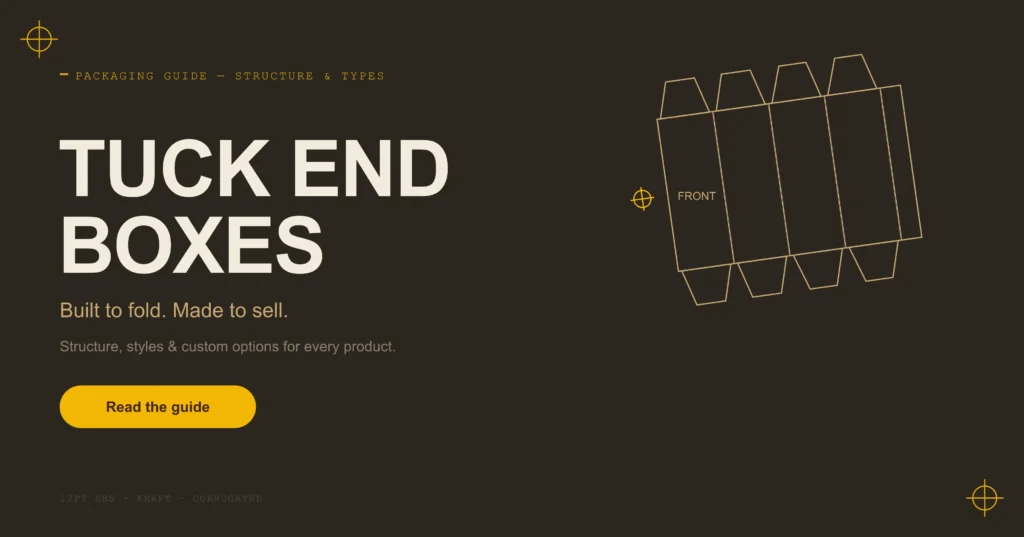
Manufacturers work from a dieline, a technical template marking every fold, cut, and score line, to make sure the printed artwork lines up exactly with the finished fold. If you’re supplying your own design files, ask your packaging partner for the dieline first; printing to the wrong dieline is the single most common cause of misaligned box artwork.
Material and Thickness Guide
Paperboard thickness (measured in points/pt or GSM) should match what the box is protecting, not just what looks premium:
| Product Type | Recommended Thickness | Material |
| Cosmetics, small electronics, tea, candles | 12–16 pt (300–400 GSM) | SBS paperboard, coated cardstock |
| Food, supplements, retail apparel | 16–18 pt (400–450 GSM) | Kraft, folding boxboard |
| Bottles, glassware, heavier retail goods | 18–24 pt (450–600 GSM) or E/F-flute corrugated | Corrugated, rigid-lined kraft |
Kraft paper and recycled paperboard are the most common eco-conscious choices, while coated white SBS gives the sharpest print detail for full-color branding.
Types of Tuck End Boxes Explained
Not every tuck end box is built the same way, and the differences affect cost, assembly time, and how the box handles weight. Here’s how the main styles compare.
Straight Tuck End Box (STE)
In a straight tuck end box, both the top and bottom flaps tuck in on the same side of the box, creating one uninterrupted front panel, ideal real estate for branding and large graphics. STE boxes are the most economical style to produce and are the default choice for lightweight items like cosmetics, small toys, and snack packaging.
Reverse Tuck Box (RTE)
A reverse tuck box, also called a reverse tuck end box, has its top and bottom flaps folding in opposite directions. This uses slightly less material than a straight tuck box and creates a more secure closure, since the flaps lock against each other rather than sitting flush. Custom reverse tuck boxes are especially popular for products customers open and reclose repeatedly, like gum, supplements, or small hardware.
Roll End Tuck Top Boxes (RETT)
Roll end tuck top boxes close with a rolled, curved flap at the bottom instead of a straight tuck, giving extra rigidity and a smoother finish along the base. The top typically still uses a standard tuck flap. This hybrid structure suits mid-weight products, think tea boxes, specialty foods, or gift sets, where the bottom needs more load-bearing strength than a pure straight or reverse tuck can offer.
Roll End Tuck Front Box (RETF)
The roll end tuck front box takes the rolled-end concept and moves the tuck mechanism to the front face rather than the top, so the box opens like a drawer or flip-front display. This style is common in retail displays and product lines where shelf presentation matters as much as protection, the front-facing tuck doubles as a mini display window when left slightly ajar.
Comparison at a Glance
| Style | Flap Direction | Best For | Relative Cost |
| Straight Tuck End | Same side, top & bottom | Lightweight retail, cosmetics | Lowest |
| Reverse Tuck End | Opposite sides | Repeated open/close items | Low |
| Roll End Tuck Top | Rolled bottom, tuck top | Mid-weight, food, gifts | Medium |
| Roll End Tuck Front | Rolled end, front-tuck | Retail display, dispensing | Medium |
Why Businesses Choose Custom Tuck End Boxes
Custom tuck end boxes solve three problems at once: protection, presentation, and cost control.
- Flat-shipped, fast to assemble — no specialized labor or equipment needed on the packing line.
- Print-ready surface — CMYK, Pantone spot colors, foil stamping, embossing, soft-touch lamination, and spot UV all sit well on paperboard.
- Lower freight cost — flat-packed cartons take a fraction of the cube space that pre-formed rigid boxes do.
- Brand storytelling — a well-designed custom boxes program (logo, color palette, QR code, sustainability messaging) turns packaging into a marketing channel instead of just a container.
Industries that rely most heavily on this style include cosmetics and skincare, food and confectionery, supplements and pharma, e-commerce/subscription boxes, and electronics accessories, anywhere a product needs to look good on a shelf and survive a supply chain.
How to Choose the Right Tuck End Box for Your Product
Most buyers overcomplicate this decision. Work through it in this order:
- Weight and fragility first. Under 200g and rigid (like a lipstick or phone case) → straight or reverse tuck. Over 500g or breakable (glass, ceramics) → roll end tuck top or corrugated.
- How often will it be reopened? Single-use retail sale → straight tuck. Reclosable/repeat-use → reverse tuck end.
- Shelf vs. e-commerce. Retail shelf display with strong branding needs → roll end tuck front for a display window effect. Direct-to-consumer shipping → prioritize corner strength over display flair.
- Sustainability requirements. If your brand markets on eco-credentials, specify FSC-certified kraft or recycled board up front, it affects both the quote and the print method available.
- Budget vs. finish. Spot UV, foil stamping, and embossing add cost per unit but meaningfully increase perceived value for premium price points; skip them for high-volume, low-margin SKUs.
If you’re not sure which combination fits, a packaging consultant can review your product specs and recommend a structure before you commit to a print run, worth doing before ordering samples.
Tuck End Boxes vs. Other Custom Boxes
Tuck end styles aren’t the only folding carton option. Compared to gable boxes (built for carrying, with a handle) or seal end boxes (glued shut for tamper resistance), tuck end boxes sit in the middle: more secure than a simple sleeve, but faster to assemble and cheaper than a fully glued or rigid box. If your product needs tamper-evidence for regulatory reasons, over-the-counter pharma, for instance, a seal end or tamper-band tuck box is usually a better fit than a standard reverse tuck.
Sustainability in Tuck End Packaging
Because tuck end boxes rely on fold-and-tuck mechanics instead of adhesive across the whole seam, they’re inherently lower in glue content than many carton styles, which simplifies recycling. Choosing FSC-certified or recycled kraft paperboard, water-based inks, and skipping laminate finishes (which can complicate curbside recycling) are the three highest-impact choices if sustainability is part of your brand positioning. The Sustainable Packaging Coalition publishes design guidelines worth reviewing before finalizing a dieline if this is a priority for your business.
Frequently Asked Questions
What is the difference between a straight tuck end box and a reverse tuck box? A straight tuck end box has both flaps tucking in on the same side, giving a clean, uninterrupted front panel. A reverse tuck box has flaps tucking in on opposite sides, which uses less material and creates a more secure, reclosable seal, better for products that get opened and closed repeatedly.
What materials are tuck end boxes made from? Most tuck end boxes use SBS paperboard, kraft paper, or folding boxboard, with corrugated stock reserved for heavier items. Thickness typically ranges from 12 pt for lightweight cosmetics up to 24 pt or corrugated flute for bottles and glassware.
Are roll end tuck top boxes more expensive than straight tuck end boxes? Yes, typically. Roll end tuck top boxes use a curved, reinforced bottom that adds a manufacturing step compared to a straight tuck’s flat fold, so per-unit cost usually sits slightly above a basic straight or reverse tuck end box.
Can tuck end boxes be recycled? Yes. Since they’re made from paperboard or kraft with minimal adhesive, tuck end boxes are widely accepted in standard paper recycling streams, provided they don’t have non-recyclable laminate or foil coverage across the full surface.
What is a dieline, and do I need to provide one? A dieline is the technical fold-and-cut template a printer uses to align your artwork with the box’s structure. Most custom packaging suppliers, including Tuck End Boxes, provide the dieline once you confirm your box dimensions and style, you don’t need to create one yourself.
What’s the minimum order quantity for custom tuck end boxes? Minimums vary by supplier and print method (digital vs. offset), typically ranging from a few hundred units for digital short runs to a few thousand for offset. Request a quote with your target volume to get an exact figure.
Get Custom Tuck End Boxes Built Around Your Product
Whether you need a straight tuck end box for a cosmetics line, a custom reverse tuck box for a supplement brand, or a roll end tuck front box for retail display, the right structure comes down to your product’s weight, how customers use it, and how it needs to look on a shelf. Tuck End Boxes works with brands to spec, print, and produce every style covered here, from single-color kraft runs to fully finished, foil-stamped custom boxes.
Request a free quote and get a dieline, material recommendation, and pricing for your exact product within one business day.